
Show & Tell

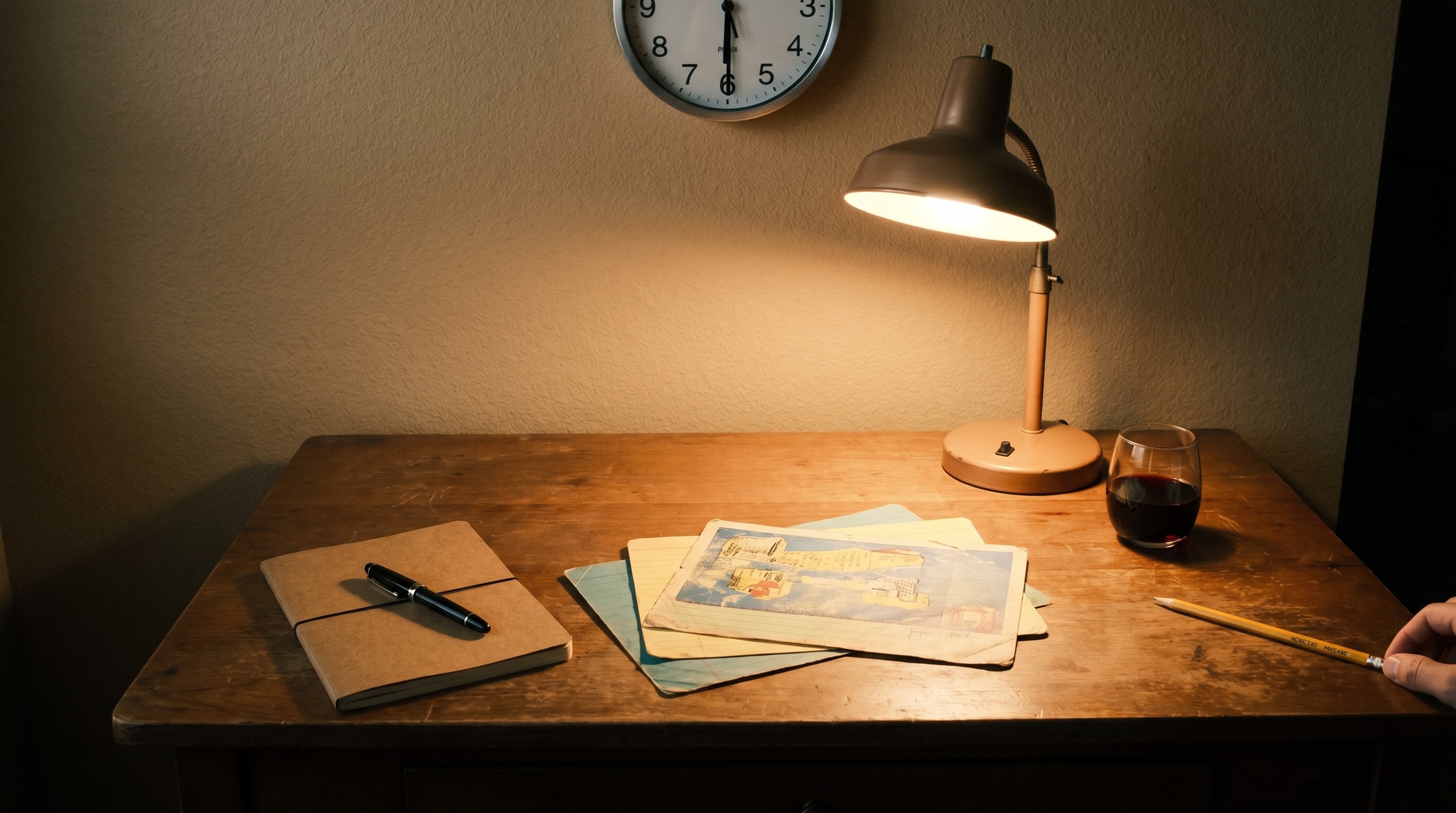
Frida Martinez is in the gravel lot before the canopies go up.
It's 5:40 in the morning. The light is still gray. She's walking the rows while the growers unload from their trucks, a steel mug going cold in her hand, no shoot today, no client, no reason she'd give anyone who asked. There's a woman named Dolores setting out strawberries - small, dark, a little ugly, two weeks early because of the warm March. Frida lifts one, turns it in the light. Buys the whole flat she doesn't need. Sets it on the Bronco's passenger seat where she can smell it on the drive.
That image - Frida at the market, alone, before anything official begins - is the Show.
The Tell is what the episode is careful not to say out loud until the very end: she doesn't come here because the division needs produce. She comes because this is the only place all week where she's nobody's boss. Where the standard is decided by the strawberry, not by her.
That gap - between the image (a division lead at a market, doing her sourcing) and the thing under the image (a person escaping the weight of being the one who decides) - is the entire architecture of this week's episode. And it's the whole of the Storyteller Tactics card that built it.
Show & Tell
The Pip Decks Storyteller Tactics card is called Show & Tell, and the principle is deceptively simple: the image and the caption are a washing line. The image leads. The caption deepens it. A new image arrives. The caption refers forward, pointing toward it. Back and forth. Neither end carries the weight alone - the line holds because both ends are pegged.
The card is filed under Style / Control Our Attention, and that's the precise category: this isn't a structural move, it's an attentional one. It's about what you ask the audience to look at and what you ask them to hold simultaneously. The image controls what they see. The caption controls what that image means. Get both right and the washing line pulls taut. Get either one wrong and the whole thing sags - the caption describes the image (boring) or drifts from it (confusing), and the audience, who can feel the slack, quietly stops paying attention.
What makes the card harder than it looks is the second move it requires: the Tell has to tell something the Show can't carry alone. Not mood. Not description. Information the image cannot contain. The strawberry in Frida's hand looks like sourcing. The Tell says it's escape. The monitor in the dark room looks like a creative director doing her job. The Tell says it's the one place left where she can make something come out right. The image is the surface. The Tell goes underneath.
And the cardinal rule: they have to peg each other. The image makes the Tell land. The Tell makes the image mean something it wouldn't mean without it. Either one alone is half a post. Together they close.
That's the tactic. Here's how the Munchies Episode 1 used it across five characters, five days, and one week.
How the episode used it
The episode opens with Frida and closes with Mindy, and the distance between those two scenes is the whole Show & Tell principle played at episode length rather than post length.
Frida's Monday is the establishing Show: division lead, market, produce, early morning. Clean. Competent. Exactly what it appears to be. The Tell is buried in the closing line of the scene - the day and the division that was, whether she wanted to think about it this early or not, hers. The episode doesn't underline it. It trusts the audience to catch the weight in that sentence, the small drag of the word hers when it's earned and also heavy. That's the washing line established in frame one: the image carries authority, the caption carries ambivalence, and the gap between them is Frida.
Chloe on Tuesday is the episode's cleanest Show & Tell pairing. The Show: a 22-year-old, casual, present-tense, not performing. The Tell: she has a show, she knows her takes are right, and the ease is the residue of effort she's hidden. The card warns against the failure mode where the caption just confirms what the image already says. Chloe's scene avoids it by letting the image look ordinary while the caption makes the ordinary image strange - she's younger than she looks in the frame and more certain than anyone in the frame expects. The gap is the character.
Jayme's Wednesday is the most structurally pure use of the tactic in the episode. The image is water, stillness, early light - all Show, nothing hidden. The caption is almost entirely Tell: what the water does for her, why she keeps coming back, what she's working to hold. Neither can carry the post. The image without the caption is a lake. The caption without the image is abstraction. Pegged together, they create someone the audience will recognize later in the season doing hard things at a client table - and they'll remember the lake.
Melissa's Thursday is the washing line at its most tension-loaded, and it's the one the episode handles most carefully. The Show is a professional at her desk, building toward something. The Tell is one sentence: the pitch is coming together. The timing is the question. Two sentences, actually, and the second one is doing all the work - because the timing is the question is technically about a client brief and is also, if the audience is paying attention, about a ceiling she's been pressing against since before the episode started. The image makes the caption look like professional confidence. The caption makes the image feel like a long breath held. The episode plants it and moves on. That's correct - you peg the washing line once per scene; you don't explain the line.
Mindy on Friday is where the episode cashes its whole week.
She's at the monitor in a dark room with the selects from the clean-label shoot. Frame 0847. The light did what it was supposed to do. She marks it. Then the phone lights up on the desk.
She looks at it. Doesn't pick it up right away. Lets it sit face-up. Something passes across her face in the dark that no one is there to see. Then she turns it face down and goes back to the selects.
The Show is a creative director, doing her job, finding the right frame. The Tell is a phone turned face down on a dark desk in Dallas, still lit with something none of them can hear.
The episode closes on Mindy driving home, radio off, telling herself it was a good week. The first half of the sentence was true. She lets it carry the second half. The washing line is fully pegged here: the image is work completed, standards met, call it; the caption is a woman carrying something she has not yet named even to herself. Neither one is the whole story. Both together are the only story that matters.
Saturday's fire pit - Frida and Jayme in the quiet, Mindy not there, Chloe and Casandra laughing at something across the property - is the episode's closing image. No caption needed. The week did the work. The audience can feel what each absence and presence means because the washing line has been running since Monday. What you see is the fire. What you hold is everything under it.
Three things to take into your own work
The Tell has to tell something the image can't carry. This sounds obvious and it is almost never done. The temptation in any caption is to confirm what the image already shows - to say at the market under a market photo, deep in the work under a laptop photo, golden hour energy under a golden-hour photo. The card is a direct instruction to not do this. The caption's job is to go underneath, to say the thing that isn't visible, to create a gap between the surface and the layer below it. That gap is what the audience comes back for. An image that matches its caption is a closed thing. An image that creates a gap with its caption is an open one.
The washing line is a structural commitment, not a post-by-post decision. Frida's Monday only works because Mindy's Friday exists. Chloe's Tuesday ease only registers because Jayme's Wednesday weight follows it. The Show & Tell principle applied at episode length means every image and caption in the week is part of a single continuous line - the images pulling one direction, the captions pulling another, the whole week held taut between them. If you apply the card to individual posts in isolation, you'll get five good posts and no episode. The line requires both ends to be pegged at the same tension.
Let the Tell be one true thing, said once. Melissa's pitch is coming together. The timing is the question. That's it. Jayme's lake is a practice, not a mood. That's it. Mindy's light did what it was supposed to do. That's it. The card's discipline is in the economy: the Tell doesn't explain itself, doesn't hedge, doesn't overqualify. It says the one true thing and trusts the image to make it land. The moment you say two true things in a single caption, you've made the audience work too hard. They'll feel the slack. Say the one thing. Let the image carry the rest.
The Marfa Munchies Episode 2 begins today. The Tell for next Sunday covers Voyage & Return - the episode that asks whether the room you come back to is different because you went. Episode 2 podcast is available on Apple Podcasts and via RSS at marfastrategy.com. | ai assisted fictional content | @galluccinet