Two Fires Under the Same Stars
What you see is what it is.

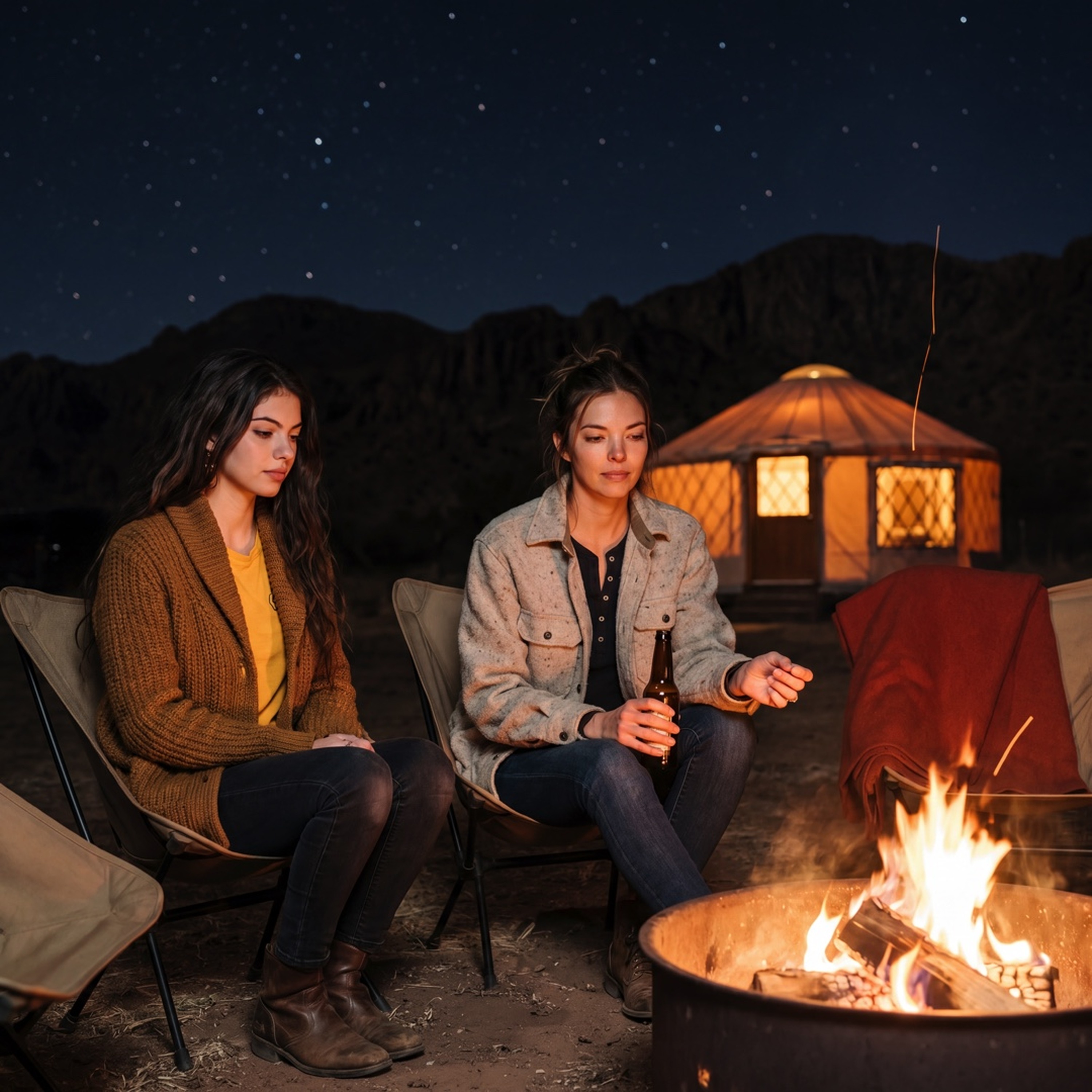
Not everyone made it out to Marfa on the same weeks, and not everyone who made it out came to the fire pit, but the fire pit burned on Friday nights regardless, because that was the social contract of El Cielito and the company had bought the contract along with the land.
Frida came out late, because Frida always came out late, and found Jayme already there in a low chair with a beer she wasn't drinking, watching the flames the way she watched the lake. The two of them had the easy quiet of people who'd worked together long enough to not need to fill it. Somewhere across the property a yurt glowed amber. The Davis Mountains were a darker dark against the dark sky, and the stars out here were obscene, the kind of sky that made people from cities go quiet the first time and quieter the second.
"Good week," Frida said, lowering herself into the next chair.
"Good week," Jayme agreed.
They let it sit. A log shifted and threw sparks. Frida thought about the strawberries, two weeks early, and what Dolores had said about the heat coming, and she thought - not for the first time and not in any way she'd say tonight - that the division felt a little like that. Early fruit. Good now. A warm spring that wouldn't last, a heat coming that nobody at the fire was talking about. She didn't have a fact to attach the feeling to. She just had the feeling, the way she'd had it about the strawberry before she tasted it.
"Melissa's got a thing she wants to pitch," Jayme said, apropos of nothing, her eyes on the fire.
Frida looked over. "You've seen it?"
"No. But she's got the face." Jayme took a sip she'd been not-taking for ten minutes. "I've known her fifteen years. She's got the face she gets right before she asks for something she's already decided she wants."
"You going to let her?"
Jayme didn't answer right away, and the not-answering was the answer, the same shape of not-answering that lived in every let's revisit after the summer. "I'm going to do what's responsible," she said finally, which they both knew was not the same as yes, and Frida - who led from the front and trusted instinct over caution and would, if it were her division, probably have said yes already - let it go, because it wasn't her division, and because the fire was warm, and because some conversations were better had in September than in May.
Mindy did not come to the fire. Mindy had driven home to Dallas, radio off, phone face down in her bag. Chloe and Casandra had built their own smaller fire on the other side of the property and were laughing at something on a phone, twenty-two and twenty-eight, cataloguing the night. And on the far side of the compound, though none of the Munchies women would have noted it as anything, the outdoor crew had their own fire going - Eddie's voice carrying, Rachel's laugh, the particular sound of a different division that shared a building and a desert and not much else. Two fires. Same dark. The worlds didn't touch tonight. They just burned, separately, under the same indecent stars.
Frida looked at the flames and felt the heat coming, and said nothing, because it was a good week, and the good week was true.
If you'd watched the whole week - if you'd followed all of it, the way the audience that follows everything follows everything - you'd have a feeling by Saturday that you couldn't quite put into a sentence.
You'd have seen five women doing excellent work. Frida at the market before the market existed. Chloe with her show and her earned ease. Jayme on the dock with her ten minutes. Melissa at the laptop with the pitch that was ready. Mindy at the monitor, finding the frame that didn't lie. Five surfaces, clean and competent and exactly what they appeared to be.
And under each one, if you'd been paying attention, you'd have caught the other thing. That Frida went to the market to be nobody's boss. That Chloe's ease was the residue of effort she'd hidden. That Jayme's lake was holding back a weight she'd named to no one. That Melissa's pitch was a held breath about a ceiling. That Mindy's phone, face down on the desk, was the first visible edge of something she was working very hard to keep invisible.
The image and the thing under the image. The show and the tell. The surface said these are five people who are very good at their jobs, and that was true, and the surface said it completely. But the surface was not the whole of it, was never the whole of it, and the gap between what they showed and what they carried was exactly the size of the thing the audience would come back for.
That was the trick of it, the architecture of the whole season laid down in a single week: what you see is what it is. The market is a market. The lake is a lake. The pitch is a pitch and the selects are selects and the show is a show.
And it is also, every single time, what it isn't. The thing under the thing. The weight under the lake, the speed under the strategy, the phone under the Friday night.
They were very good at their jobs.
That was the part they let you see.
The part they didn't was a phone, face down on a dark desk in Dallas, still lit with something none of them could hear. Mindy had carried it home and set it down and told herself the week was good. The phone would still be there Monday. So would whatever was on it.
This entry is part of The Marfa Munchies, a daily fiction podcast from The Marfa Strategy.
Listen daily. Apple Podcasts · RSS
Follow the world. @marfamunchies on Instagram · TikTok · Threads · Bluesky